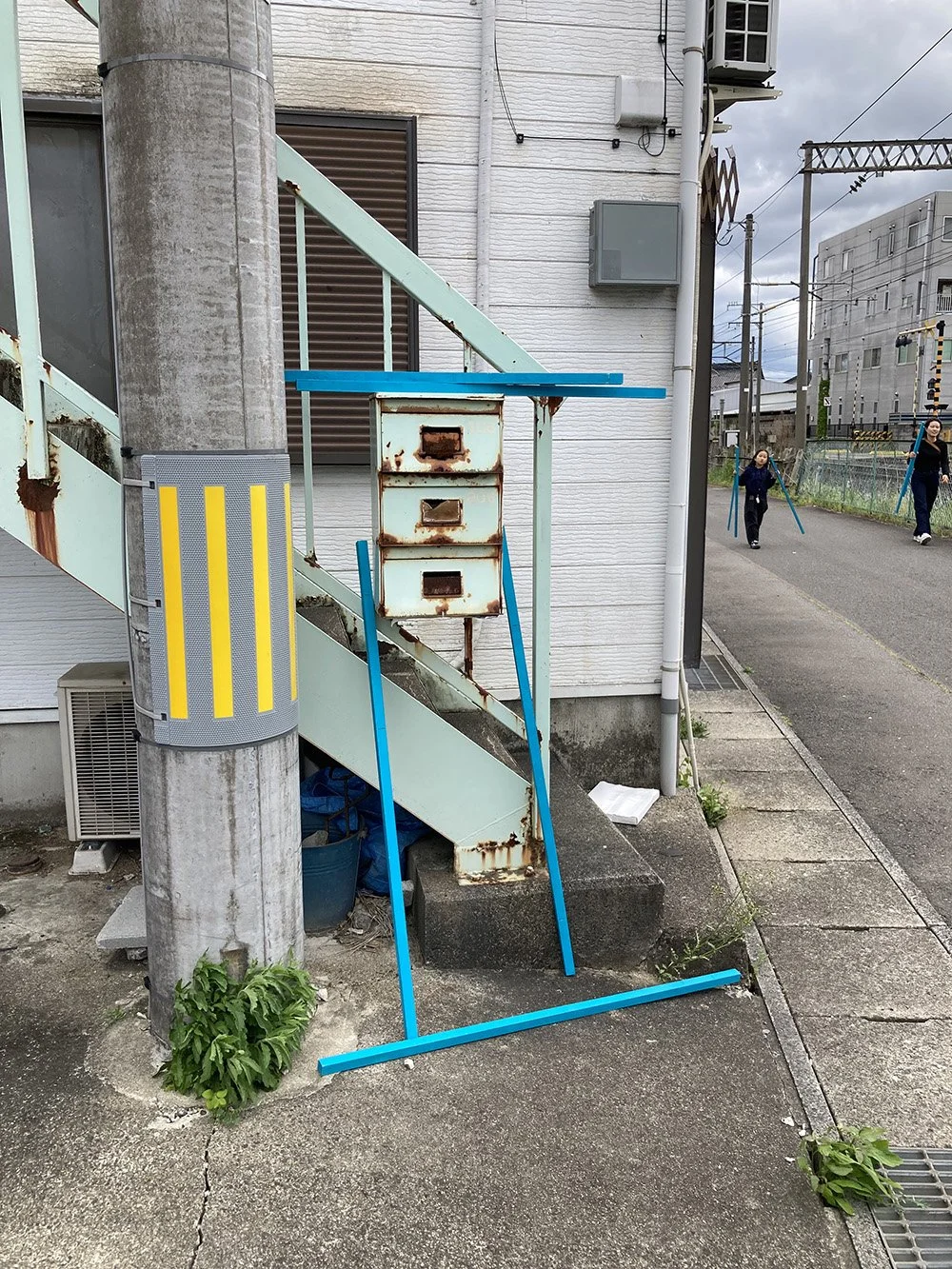
”site—representation” Fukushima Art Annual 2025
mixed-media installation
Fukushima Prefectural Museum of Art, Japan
This installation work was created for the Fukushima Art Annual 2025 exhibition titled “site—representation.” Focusing on the interaction between artificial objects and nature that occurs between private and public spaces in urban environments, the work takes motifs such as "vacant Lands," "Passage," and "walls" to reconstruct latent, intermediate zones within the city as a unique form of "garden"—an installation. The exhibition space is composed of four main parts: "Vacant Land (Shelter) / Plastic Relics," "Passage (Tracing Boundary)," "Palimpsest (Collaged Wall)," and"Words of Situation."
このインスタレーション作品は、福島県美術館において開催された『福島アートアニュアル2025「site—representation」』出展に際し制作された。都市環境の中のプライベートスペースとパブリックスペースとのあいだで生じる人工物(モノ)と自然との干渉を焦点としながら、「空き地」、「歩道」、「壁」などを主なモチーフとし、都市空間の中に潜在する中間的な領域を独自に「庭」=インスタレーションとして再構成する。会場構成は大きく4つのパート、「Vacant Land(Shelter) / Plastic Relics」、「Passage (Tracing Boundary)」、「Palimpsest (Collaged Wall)」、「Words of Situation」に分かれる。


Passage ( Tracing Boundary )
2025
mixed-media Installation
My work takes as its motifs residual objects abandoned in urban boundaries—or threshold-like spaces—such as streets, the areas between private residences and public roads, and vacant lots, as well as discarded everyday objects, weathered architectural walls, and fragments of urban infrastructure. I focus on their ambiguous forms, whose original purposes and functions cannot be readily identified, and on forms that evoke archaeological artefacts.
In this work, I create sculptures by replicating these motifs or abstracting their forms. Within the exhibition space, I bring together forms with varying degrees of abstraction, ranging from near-replicas to those abstracted to the point that their original motifs are almost impossible to identify.
By juxtaposing these forms, the installation produces multiple stages of recognition: although they all derive from objects found within the same urban environment, some are perceived as concrete objects, others retain faint traces of their former purposes and functions, while still others are perceived as pure forms. In this way, the work visualises the gaps and disjunctions that arise between the forms before us and the meanings they evoke. At the same time, works that directly replicate urban residues create a connection between the exhibition space and the actual city and its pavements beyond the walls of the museum.
路上や住宅と公道のあいだ、空き地など、都市における境界、あるいは「敷居」的な場所に放置された残余物や、不要となった日用品、風化した建築の壁、都市インフラの断片などをモチーフとし、それらの用途や機能を容易には判別できない曖昧な形や、考古遺物を思わせる形態に着目する。
この作品では、それらのモチーフを複製したり、その形態を抽象化したりすることによって作品を制作している。その際、複製に近いものから、もとのモチーフをほとんど判別できないほど抽象化されたものまで、異なる抽象度をもつ形態を展示空間のなかに混在させている。
それらが並置されることで、同じ都市の事物に由来しながらも、具体的な物として認識されるもの、用途や機能の記憶をかすかに残すもの、純粋な形態として知覚されるものといった、複数の認識の段階が生み出される。目の前にある形態と、そこから想起される意味とのあいだに生じるずれや乖離を可視化すると同時に、都市の残余物を直接的に複製した作品は、美術館の外部に広がる現実の都市や歩道と、展示空間とのあいだに接続を生み出していく。


Palimpsest ( Collaged Wall )
Paper, acrylic paint, color pencil, photo
394mm×545mm, 297mm×420mm
“Palimpsest” refers to an ancient manuscript on which original writing has been erased and overwritten, with traces of the earlier text still faintly visible. In this work, Suzuki constructs a visual composition using photographs of objects taken during street observation, surfaces capturing wall stains, irregularly shaped color fields, and fragments of drawings. Through imagery reminiscent of the marks left after posters have been peeled off, he expresses the latent structures embedded within the urban landscape.
「Palimpsest(パリンプセスト)」は文字を消して上書きされた古文書のことで、消された文書が透けて見えることがある。本作では、鈴木が路上観察を通して撮影した事物の写真や、壁の染みを写し取った画面、不定形に切り取られた色面、ドローイングの断片などを構成し、貼り紙を剥がした跡のようなイメージから都市に潜在する構造を表現した。